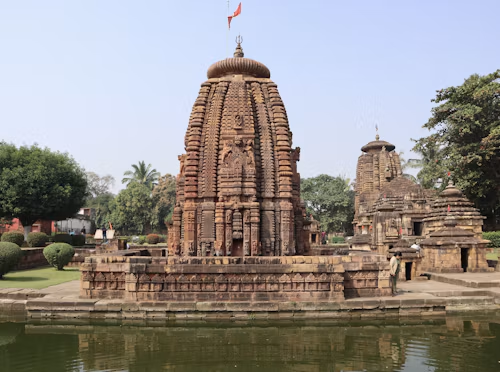
Bhubaneswar is Odisha’s capital, known as the temple city of India. Over 1,000 years ago, kings from various dynasties created hundreds of stone temples around Bindusagar Lake. Many temples are still preserved. Some are functioning temples, while others are in ruins protected by the government. Additionally, several temples can be found in different locations in the city.
Architectural enthusiasts can appreciate Kalinga architecture through Bhubaneswar’s temples. Visitors can see temples in the early periods and evolving into more complicated architectural styles in later buildings.
The city is also compact in the old quarter. Most major temples sit within a few kilometres of each other, so three unhurried days cover a lot.
Bhubaneswar day one around Bindusagar
I started in the old town near Bindusagar, the large stone-lined tank at the centre of the temple area. I walked around it in the morning when the light was soft, and the steps were quiet. Locals bathe or sit here, and the surrounding lanes feel lived in.
Lingaraj Temple is the main sightseeing attraction in Bhubaneswar. This temple was constructed in the 11th century and reaches almost 55 meters. It demonstrates the modern Kalinga architectural style with a tall and curved tower and intricate carvings.
Nearby, the Ananta Vasudeva and Brahmeshwara temples are smaller but worth the short walk. Their carved walls reward a slow look, especially in the afternoon when the stone catches warm light.
Bhubaneswar day two for early temples
On the second day, I followed the older and quieter sites. Parsurameswara Temple dates to around the 7th century and is among the city’s oldest surviving temples. It is modest in size, but the carvings on its walls are sharp and detailed. Visiting early means fewer people and cooler air.
The Mukteshvara Temple is located nearby and is widely regarded as one of Odisha’s most exquisite temples. It stands out for its remarkable entrance gate, called a torana. The intricate carvings look neat, as they were done with great attention to detail, while the small size permits one to admire them closely. Next to this temple, one can find a quaint pond that adds tranquillity to the monument.
Rajarani Temple, from the 11th century, has no active deity and is kept as a protected monument. A small entry ticket applies. The lawns around it are neat, and the figures carved along the walls are some of the finest in the city. Late afternoon is a good time to go.
Bhubaneswar day three at the caves and Dhauli
Another attraction I explored on the last day of the visit is the Udayagiri and Khandagiri caves cut into the rock around the 2nd century BC. They are only 6 kilometres from the city centre, and these caves were once home to Jain monks. Some caves have doors, and some have inscriptions. Travellers should wear comfortable walking shoes when exploring them, as the steps may be uneven.
After the caves, I drove to Dhauli, around eight kilometres south. This is where Emperor Ashoka left rock edicts after the Kalinga War. A carved elephant emerges from the rock face, and the hilltop Shanti Stupa gives a wide view over the plains. Go in the late afternoon for softer light.
Hotels in Bhubaneswar for temple days
Where you stay affects how comfortable the plan feels. Hotels in Bhubaneswar near the old town and Lingaraj area keep you close to the temple cluster, so early walks are easy. The Kharvel Nagar and Master Canteen areas are good for transport links and food options. Hotels in Bhubaneswar around Jaydev Vihar suit travellers who prefer quieter streets and easy road access.
Whichever area you pick, choose somewhere that lets you start early. Most temples are at their best in the morning.
Bhubaneswar beyond the three days
If you have more time, then visit Konark and Puri, located around 65 km from the city, for further coastal and historical exploration. Even without that, Bhubaneswar gives a clear and unhurried look at how Odisha’s temple builders worked, century by century.